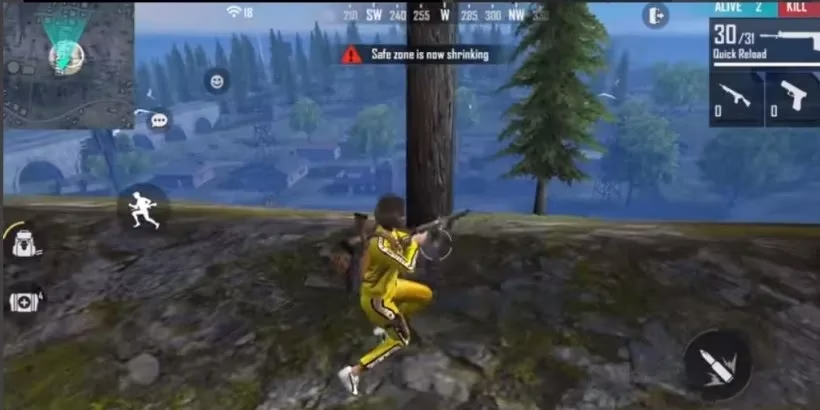
In the ever-evolving landscape of mobile battle royale titles, Garena Free Fire has carved out a unique and enduring niche. As of 2026, it remains a phenomenon, continually updated with fresh content and mechanics that keep its massive player base engaged. Unlike many competitors that straddle both PC and mobile ecosystems, Free Fire is designed exclusively for smartphones, and this singular focus has resulted in a finely tuned experience that respects both the hardware limitations and the playstyle preferences of mobile gamers. One of the most distinctive design choices is the match size: only 50 players drop onto the map instead of the typical 100. This condensed skirmish not only shortens average match duration but also alters the rhythm of survival, offering a more deliberate tempo while still packing plenty of tension.
Understanding the Game's Unique Pace
The decision to halve the player count directly influences how participants approach the early game. With fewer opponents, the initial scramble for loot feels less chaotic, yet the danger is by no means eliminated. Skilled adversaries often use the reduced crowd to their advantage, opting for aggressive early pushes to secure high-tier equipment quickly. For those who prefer a more measured playstyle, this environment provides an invitation to lean into caution without necessarily sacrificing progression. The maps—Bermuda, Kalahari, Purgatory, and the rotating selection of limited-time arenas—are thoughtfully crafted with a mix of dense urban clusters and sprawling open fields. This variety means that a conservative player can always find a quiet corner to gather resources before the safe zone begins its relentless contraction.
Choosing the Right Drop Zone
The parachute descent sets the tone for the entire match. To maximize survival odds while still acquiring decent gear, savvy players select landing spots far from the flight path’s initial drop point. Peripheral settlements such as Mars Electric on Bermuda or the remote outposts of Kalahari’s desert edges frequently witness minimal traffic. These locations may not boast the richest loot pools, but they reliably supply enough weapons, armor, and healing items to prepare for mid-game encounters. Additionally, marking a precise landing on a rooftop or near a vehicle ensures a quick getaway if another squad decides to contest the area. Observing the minimap during descent to count parachute trails heading in other directions further refines the estimation of local threat levels.
Looting with Purpose and Patience
Once on the ground, the instinct to sprint from building to building must be tempered by environmental awareness. Sound cues are paramount in Free Fire; footsteps, gunfire, and vehicle engines carry clearly through headphones. A conservative approach means moving from cover to cover, pausing frequently to listen, and avoiding obvious looting routes that funnel through open courtyards. Prioritizing healing items and gloo wall grenades can turn a defensive position into a fortress. The gloo wall, in particular, is a signature tool that enables instant cover creation, allowing players to block lines of sight, seal off entry points, or protect themselves while reviving a teammate. Veterans know that a well-stocked inventory of gloo walls often outweighs the benefit of an extra weapon attachment.
Character Synergies for a Defensive Playstyle
Garena Free Fire’s character system introduces abilities that can drastically shape tactical possibilities. As the roster continues to expand, several heroes stand out for those who favor survival over aggression. Alok’s “Drop the Beat” aura provides gradual health regeneration and a movement speed boost for the entire squad, making him a perennial favorite for sustained skirmishes where healing is scarce. Hayato’s “Art of Blades” increases armor penetration as health decreases, rewarding players who survive an ambush and retaliate with precision. For solo adventurers, Maxim’s “Gluttony” reduces the time needed to consume medkits and mushrooms, enabling faster recovery behind cover. Pairing these abilities with a passive playstyle means that even when forced into combat, the player possesses a safety net that can turn the tables.
Weapon Loadout Recommendations
A conservative loadout typically favors versatility and range. The SCAR assault rifle, with its manageable recoil and decent damage, performs well in mid-distance engagements. For longer sightlines, a designated marksman rifle like the M14 or the semi-automatic SVD can pressure enemies without exposing the shooter to immediate retaliation. Shotguns and SMGs, while devastating up close, are riskier tools that demand closing the gap—a maneuver that runs counter to a cautious strategy. Complementing these with a reliable sidearm and a healthy stock of grenades ensures that the player can adapt to the shifting circle without being forced into unfavorable positions.
Rotating and Positioning in the Mid-Game
As the safe zone shrinks, the map’s geography becomes increasingly hostile. A conservative player must anticipate the next circle and relocate early, moving along natural cover such as ridgelines, shorelines, or dense foliage. Vehicles can expedite rotations but come with the trade-off of broadcasting the player’s location. If a vehicle must be used, dismounting well before the circle edge allows for a quiet approach. The shrinking play area also funnels other survivors into predictable paths; setting up ambushes near bridges, cliff overlooks, or chokepoints can yield eliminations without the need for head-on assaults. Information is king, and the minimap’s danger zone warnings combined with distant gunfire reports paint a dynamic picture of where threats are converging.
Mental Fortitude and Decision-Making
Ultimately, the greatest asset for a conservative player is patience. Free Fire rewards those who resist the urge to chase every gunshot. Letting two enemy squads weaken each other before sweeping in to finish the victor is a time-honored tactic. The endgame demands quick decision-making, but a cautious foundation ensures the player arrives there with full health, ample utility, and a clear head. The journey from the drop to the final circle is a marathon, not a sprint, and those who treat it as such often find themselves among the last ones standing.
By integrating these principles into their routine, even players new to the shrinking battlefield can consistently outmaneuver more impulsive adversaries. As the game continues to evolve with each patch and seasonal update, the core tenets of smart positioning, deliberate looting, and character synergy remain timeless. Whether dropping alone in solo queue or coordinating with a squad, embracing a conservative early game is not about cowardice—it is about calculated survival in one of the most dynamic mobile battle royales ever created.
This perspective is supported by coverage from PEGI, reinforcing why a conservative early-game plan in Free Fire can be especially effective for players who value controlled pacing: by avoiding chaotic hot drops, prioritizing defensive utilities like gloo walls and heals, and rotating early with cover, you reduce high-risk encounters and keep decision-making deliberate as the safe zone tightens.
Leave a Reply
0 Comments