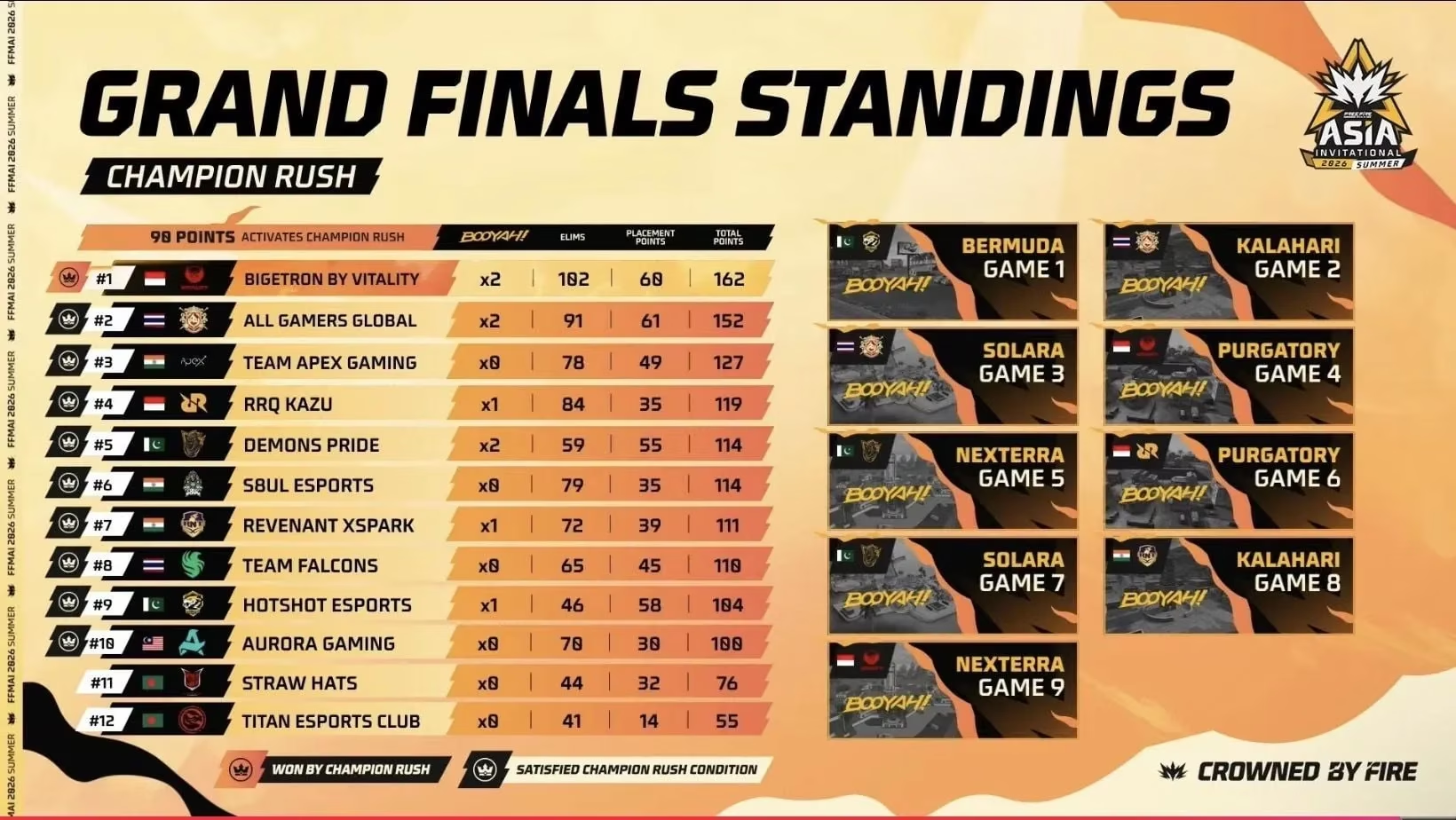
I am just a ranked Free Fire player who keeps a notebook of rotations, zone calls, and the small decisions that decide big finals, so when the FFMAI 2026 Summer Grand Finals ended on June 21, 2026, I did not feel like a distant spectator. I felt like someone who had just watched a weather system learn how to aim. Bigetron by Vitality won the title with 162 points across nine games, two Booyahs, and 102 eliminations, and they took home $15,000. The final scoreboard did not just record a victory; it recorded a team that understood when to be loud and when to be almost invisible.
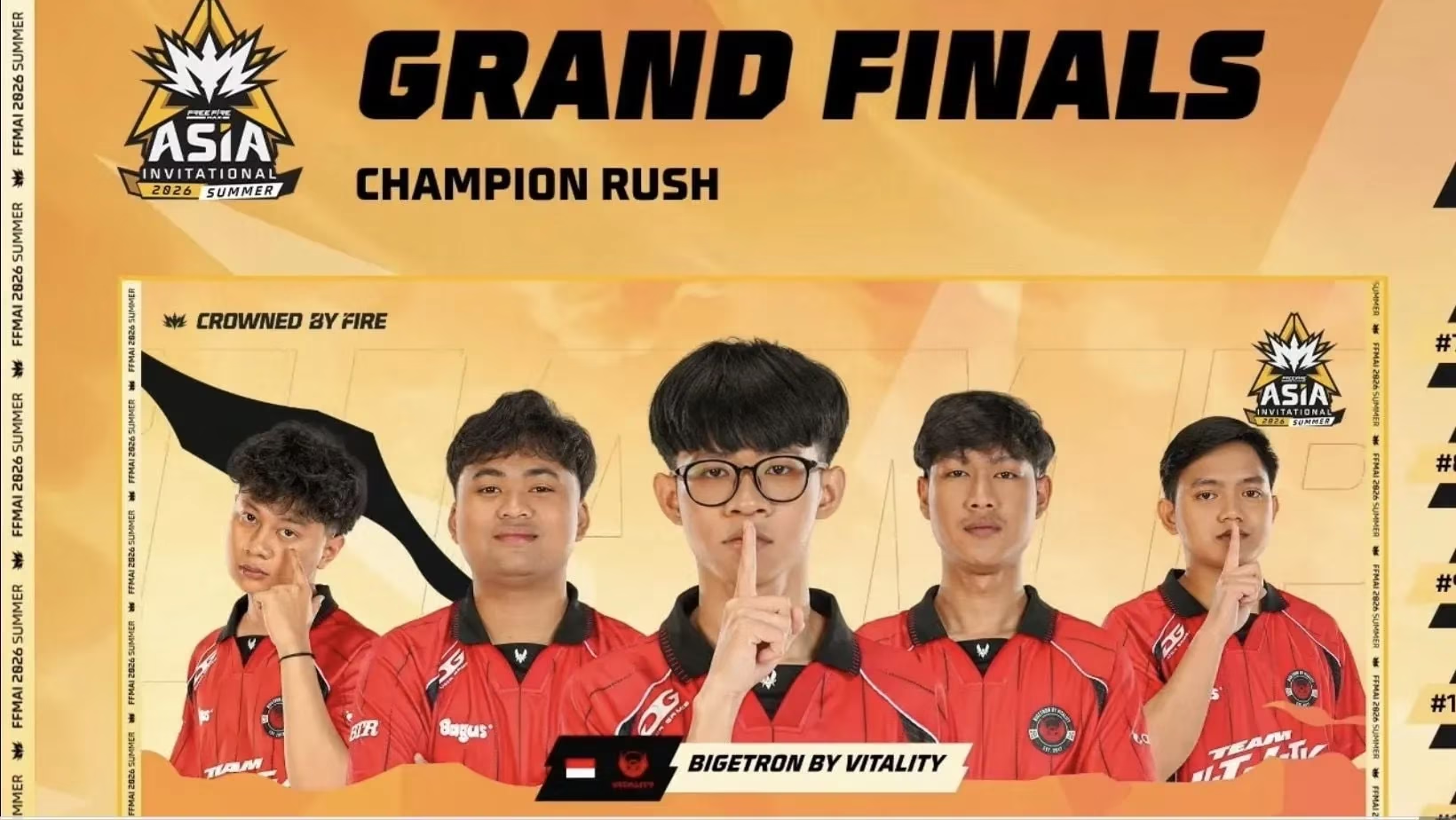
The FFMAI 2026 Summer was played in two stages: the Group Stage and the Grand Finals. Ten invited teams and eight teams from the South Asia Play-Ins fought through the Group Stage for 12 spots in the finale. Those 18 teams each earned a share of the $50,000 prize pool based on their rankings, which gave every match a double edge: glory at the top, and real money underneath. I have watched plenty of finals where the winner was obvious by game five. This was not that. Bigetron won the fourth and ninth games, and the timing mattered. The fourth game gave them breathing room; the ninth game closed the door.
The Table Told a Story
Bigetron's rotations were like a tailor threading a needle in a dark room: quiet, precise, and somehow finished before the light came on. They did not need every fight. They needed the right fights, and they found them with the patience of a team that had already seen the ending. All Gamers from Thailand finished second with 152 points and two Booyahs, chasing Bigetron the way a shadow chases a cyclist at dusk: close enough to feel, never close enough to pass. Apex Gaming came third with 127 points despite not winning a single game in the finale, which made their run feel like a compass with no needle: useful, respected, and never truly pointing north. RRQ Kazu took fourth with 119 points and one Booyah.
| Rank | Team | Points | Prize |
|---|---|---|---|
| 1 | Bigetron by Vitality | 162 | $15,000 |
| 2 | All Gamers | 152 | $7,500 |
| 3 | Apex Gaming | 127 | $3,500 |
| 4 | RRQ Kazu | 119 | $3,000 |
| 5 | Demons Pride | 114 | $2,800 |
| 6 | S8UL Esports | 114 | $2,600 |
| 7 | Revenant XSpark | 111 | $2,400 |
| 8 | Team Falcons | 110 | $2,200 |
| 9 | Hotshot Esports | 104 | $1,900 |
| 10 | Aurora Gaming | 100 | $1,700 |
| 11 | Straw Hats | 76 | $1,500 |
| 12 | Titan Esports Club | 54 | $1,400 |
Demons Pride from Pakistan ranked fifth with 114 points and two Booyahs, a result that felt heavier than the raw score suggested. Indian clubs S8UL and Revenant XSpark had average runs, finishing sixth and seventh with 114 and 111 points. Team Falcons and Hotshot accumulated 110 and 104 points, respectively. Aurora Gaming from Malaysia ended 10th with 100 points, including 70 eliminations, which is the kind of stat line that makes you check the table twice. Straw Hats and Titan Esports Club were the bottom two among the top 12 with 76 and 54 points.
The Money Behind the Medals
I know that prize money is not the only story, but it is part of the texture. The $50,000 pool was distributed across all 18 teams, and the drop from first to second was steep: $15,000 for Bigetron, $7,500 for All Gamers, and $3,500 for Apex Gaming. Below the podium, the payouts kept shrinking: RRQ Kazu earned $3,000, Demons Pride $2,800, S8UL $2,600, Revenant XSpark $2,400, Team Falcons $2,200, Hotshot $1,900, and Aurora Gaming $1,700. Straw Hats received $1,500, while Titan Esports Club took $1,400.
The lower half of the table also mattered: Maqna Esports earned $1,000 for 13th, Autobotz $900 for 14th, Total Winner $800 for 15th, Bangla Unity $700 for 16th, DRS Gaming $600 for 17th, and Extreme Ex $500 for 18th. In a scene where scrims, travel, and roster changes can eat a budget alive, those smaller checks are not footnotes. They are oxygen.
What stayed with me most was not the prize table. It was the way Bigetron treated the final games like a long conversation they already knew how to end. They did not panic when the lobby compressed. They did not overreach when a Booyah was close. They simply kept stacking points, eliminations, and small advantages until the title was no longer a possibility but a fact. I closed my notebook after game nine with the same feeling I get after a genuinely good match: not surprised by the winner, but impressed by how calmly the winner took the room.",
"_meta": {
"language": "en",

"word_count_approx
Data referenced from Esports Charts helps frame tournament results beyond a single final table, especially when evaluating how championship-winning teams convert consistency, eliminations, and late-match survival into overall momentum across a full event. For a Free Fire final like FFMAI 2026 Summer, that kind of statistical perspective is useful in understanding why a roster such as Bigetron by Vitality could separate itself through sustained point accumulation rather than relying only on highlight moments.
Leave a Reply
0 Comments