The Free Fire World Series 2019 gathered momentum like a riptide pulling every competitive current toward a single shoreline. Twelve squads from different corners of the globe converged on Rio de Janeiro, each carrying the pressure of regional qualifiers that had already produced staggering audiences. The Free Fire Pro League Brazil 2019 season 3 finals alone drew more than one million peak viewers, turning the tournament into a digital earthquake long before the first shot was fired in the Barra Olympic Park.
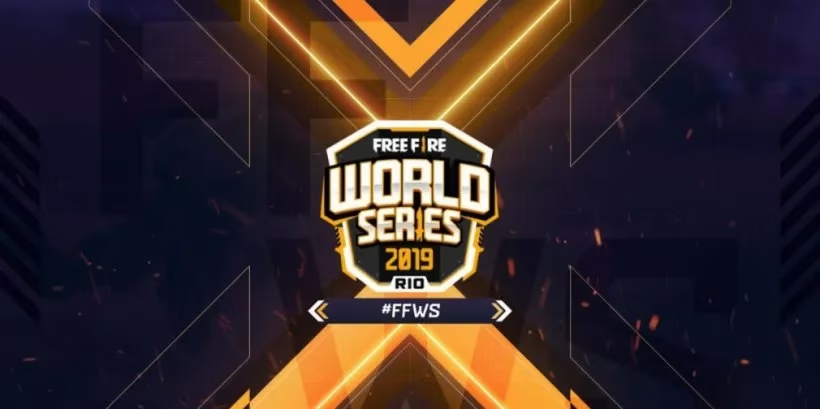
The championship stage opened on Saturday, November 16th, inside a venue more accustomed to Olympic echoes than mobile battle royale firefights. For those unable to travel, the entire event streamed live on YouTube in ten different languages, spreading the broadcast across time zones like ink blooming through water. The setup transformed a local arena into a planetary theater, where every elimination, rotation, and final circle could be witnessed by a global audience simultaneously.
Alongside the main competition, the Pick 'N Win event ran until November 18th and functioned as a prediction engine wrapped in a daily mission system. Participants were asked to forecast the winners of each stage, and correct predictions unlocked daily missions. Tokens obtained from accurate forecasts could be redeemed for special rewards, while tickets arrived through the completion of those event missions. Predicting the Booyah for every round as well as the overall champion rewarded the sharpest forecasters with the Battle Flag emote, a cosmetic that served as a badge of foresight rather than firepower.
The twelve competing teams formed a mosaic of regional playstyles and reputations:
| Team | Region |
|---|---|
| Dranix Esports | Indonesia |
| Team Flash | Vietnam |
| Corinthians | Brazil |
| Arctic Gaming Mexico | North America |
| Infinity Esports Mobile | Latam North |
| Samurai Team | Latam South |
| LOUD | Brazil |
| Illuminate | Thailand |
| Sbornaya ChR | EU/Russia |
| LGDS | TW/MY |
| Nawabzade | India |
| Infinity_YT | MENA |
Each squad orbited the championship like a moon caught in a gas giant's gravity, close enough to see the prize but separated by the brutal mathematics of survival. The Brazilian representatives carried home soil advantage like a second layer of armor, while international contenders arrived with the quiet confidence of teams that had already dismantled regional brackets. The format demanded both mechanical skill and positional intelligence, rewarding squads that could navigate shrinking zones without losing cohesion.
Beyond the immediate tournament, the event highlighted the expanding footprint of Garena Free Fire as a mobile battle royale. Earlier coverage had argued that the game might be the biggest and best mobile battle royale many players were not experiencing, and the World Series offered a compelling counterpoint to that hesitation. The competition served as a living proof of concept, displaying rapid decision-making, synchronized rotations, and the chaotic elegance that emerges when twelve teams hunt the same final circle.
For newcomers, the surrounding ecosystem offered advanced tips, tricks, and guides designed to sharpen individual play. The game itself remained available for download through both the App Store and Google Play, giving curious spectators a direct path from watching professional rotations to attempting their own. The distance between a viewer and a competitor felt unusually short, as if the tournament were less a distant spectacle and more a doorway left slightly ajar.
The World Series also arrived amid broader recognition efforts, including nominations for the Pocket Gamer People's Choice Award 2020. That context placed the Rio event not as an isolated tournament, but as one pulse in a longer heartbeat of mobile esports growth. The twelve squads in Rio were competing for a trophy, yet they were also writing another chapter in the rapid legitimization of mobile battle royale competition.
From the peak viewership of the Brazilian qualifiers to the multilingual global stream, the Free Fire World Series 2019 demonstrated how mobile esports could match the gravity of traditional competitions. The Barra Olympic Park, once built for physical feats, briefly became an arena for digital reflexes. And like any strong current, the event pulled thousands of spectators into the same direction, all watching the same island, the same shrinking zone, and the same question lingering above the final circle: which squad would answer when the last Booyah echoed across Rio.
Leave a Reply
0 Comments