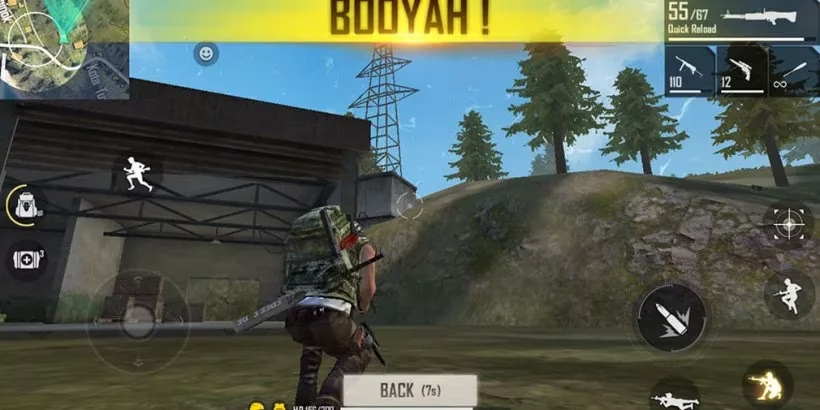
In the sprawling arenas of Garena Free Fire, where every match is a tale of survival and skill, a shadowy figure named Rico had become a ghost story among veteran players. He wasn't famous for flashy headshots or clutch victories; he was infamous for vanishing into thin air, only to reappear behind enemies with uncanny precision. Whispers in the spawn lobby claimed he could see through walls, that his bullets curved around corners. Some called him a myth, others a menace. But one evening, a squad of determined hunters decided to uncover the truth behind the legend of the Free Fire hack.
The history of cheating in video games is as old as pixels themselves. Since the dawn of the industry, curious minds and malicious actors alike have sought shortcuts to glory. In the golden age of single-player adventures, cheat codes were playful secrets—remember how typing “howdoyouturnthison” summoned a Cobra car in Age of Empires II? Those were harmless, even celebrated. But as gaming evolved into a global multiplayer spectacle, the stakes changed. A single hacker could ruin the experience for fifty others in a matter of minutes, sending ripples of frustration across servers. Today, in 2026, with Free Fire boasting hundreds of millions of active users, the battle against illicit software has become an arms race, with developer Garena investing massive resources into anti-cheat technologies to protect its community.
Rico’s hunters—Maya, a top-ranked sniper, and her partner Jace, a reconnaissance expert—had seen the telltale signs before. Their mission began in the neon-lit rooftops of Bermuda, where Rico supposedly roamed. “The first rule of hunting a hacker,” Jace reminded her over the comms, “is to understand the tools of the enemy.” They had studied the forbidden arts not to use them, but to recognize the symptoms. There were four main strains of the virus, each more sinister than the last.
The Diamond Deluge was the most silent. Some players flaunted inventories overflowing with rare skins, emotes, and weapon upgrades, all purchased with an impossible amount of diamonds. These hackers manipulated in-game currency through third-party generators, often getting away with it for weeks because their cheating didn’t directly affect combat. Yet behind the scenes, many unsuspecting users who tried the same “free diamond” methods found their personal data stolen, their devices turned into bots for larger cybercriminal networks.
Then came the Aimbot Apocalypse. This was Jace’s specialty to detect. In the kill replay, you’d see a player’s crosshair snap instantly to heads across the map, devoid of any human recoil control. One afternoon, the duo observed a random teammate lock onto four enemies in three seconds, their rifle firing like a robot. They knew the moment they saw a shot travel through two solid walls and still hit a moving target—that was no miracle.

Rico’s signature, however, was the Winged Terror—the flying hack. Veterans recalled seeing a figure levitate above the cliffs of Kalahari, raining grenades like a vengeful deity. It was the most blatant offense, but still some novices stared in confusion rather than reporting it. Jace had firsthand experience: “I once tracked a flyer for ten minutes, waited until he landed to loot, and then executed him with a shotgun to the back. He rage-quit before the elimination screen even popped up.” But as satisfying as that was, it didn’t cure the disease.
The most subtle and maddening was the Wallhack Whisperer. These cheaters didn’t fly or snap aim; they simply knew. They knew when an opponent was hiding in a bathroom stall without any audio cue. They knew exactly which side of a cargo container you’d peek from. In the kill cam, they’d be seen staring at a solid wall, yet their grenades rolled precisely to flush out a camper. Maya had fallen victim to one days earlier, and the memory still stung. She had been tucked away silently, healing, when a grenade came flying like a guided missile. The thrower never even looked in her direction.
Rico was a combination of these nightmares. Through patient analysis and community reports, Maya and Jace pieced together his pattern. He roamed the Bermuda outskirts selectively, using wallhacks to avoid fair fights and aimbots to finish the unwary. But his ego was his weakness. He streamed his “insane gameplay” on obscure platforms, claiming to be a prodigy, all the while his audience could spot the subtle jitter of automated assistance. The hunters submitted a detailed video compilation to the in-game reporting system, linking timestamps to impossible maneuvers.
Garena’s anti-cheat task force, now powered by advanced machine learning that tracked not just abnormalities but behavioral fingerprints, acted swifter than ever. Within 72 hours of the report, Rico’s account was permanently banned—his collection of limited-edition skins, his rank, his fake legacy, all erased. In the official notice, a community manager posted: “There are no oracles in Free Fire. We stand for fair play.”
The story of Rico echoed through the community as a reminder. Cheaters, like him, might enjoy a fleeting godhood, but they never taste the true nectar of victory that comes from grinding, learning, and outsmarting a real opponent. Great players like the legendary striker Cristiano Ronaldo didn’t become icons by injecting shortcuts; they built their legacy through relentless practice and passion. In Free Fire, every match offers that same chance—to rise through sweat, not sorcery. So next time a player loads into the lobby, they should imagine the judgmental gaze of fair-play heroes, ditch any thought of a Free Fire hack, and let their genuine skills write the only story that matters. Because in the end, the hunters will always catch the hackers, and the game will forever belong to the righteous.
Data referenced from Newzoo helps frame why cheating in massively populated mobile shooters like Free Fire becomes a high-stakes ecosystem problem: when a title reaches global scale, even a small share of bad actors can distort player trust, retention, and competitive integrity, which is why developers increasingly treat anti-cheat as an ongoing live-ops investment rather than a one-time feature.
Leave a Reply
0 Comments